 rdark
rdarkHistorical Darknet Markets: Seizures and Exit Scams
Historical darknet markets follow a pattern grim enough to be useful: almost none of them ended well, and the few that did proved it with a signature. This archive documents the major markets that have been seized or have exit-scammed, from Silk Road in 2013 to Abacus in 2025, each with dated and sourced detail. Read end to end, they make the case the rest of this site rests on: continuity is the exception, so verify what exists now and plan for its disappearance. Of every market below, exactly one said goodbye and signed it.
The closed-market timeline
Fourteen documented markets, and only three ways to end. Every one below closed by a law-enforcement seizure, by an exit scam in which the operators drained escrow and vanished, or, rarely, by a retirement on the operator's own terms. To a buyer the first two are nearly indistinguishable, because the site simply stops loading and which it was can take days or months to confirm. The table dates each closure, names how it ended, and links to the full case study. The one row that breaks the pattern, the signed retirement, is the one worth studying hardest.
| Market | Active | How it ended | What it proved |
|---|---|---|---|
| Silk Road | 2011–2013 | Seized — FBI took 144,336 BTC from a logged-in laptop | Bitcoin is an evidence trail, not anonymity |
| AlphaBay | 2014–2017 | Seized — Operation Bayonet, July 2017 | A market going dark can be bait for the next one |
| Hansa | 2014–2017 | Seized, then run as a police honeypot for ~30 days | "It still loads" is not a safety signal |
| Dream Market | 2013–2019 | Retired under law-enforcement pressure, April 2019 | The "official successor" is the next trap |
| Wall Street Market | 2016–2019 | Exit scam — ~$11M, arrests within days | A reused Bitcoin wallet is forever |
| Empire Market | 2018–2020 | Exit scam — ~$30M behind a DDoS excuse | The exit-scam playbook in canonical form |
| White House Market | 2019–2021 | Retired with a PGP-signed farewell, withdrawals open | What a verifiable goodbye looks like |
| Hydra | 2016–2022 | Seized — ~$5.2B lifetime, 543 BTC taken | Size is not safety |
| Kingdom Market | 2021–2023 | Seized by a five-country coalition | Network redundancy answers the wrong threat |
| Vice City Market | 2020–2023 | Exit scam — exact date never confirmed | A dead market's mirrors are all traps |
| Nemesis Market | 2021–2024 | Seized — drugs and cybercrime-as-a-service | A seizure banner can lag the takedown |
| Archetyp | 2020–2025 | Seized — Operation Deep Sentinel, June 2025 | Dark two days before any banner appeared |
| Abacus | 2021–2025 | Exit scam (suspected), July 2025 | Thriving days earlier is no defense |
| Kerberos Market | 2022–2026 | Exit scam (suspected), February 2026 | Anti-phishing won't save you from the market itself |
The first generation: Silk Road
Silk Road was the market that proved the model and the one that set the cautionary template. Launched in 2011, it ran on Tor with Bitcoin escrow until October 2013, when the FBI arrested Ross Ulbricht and seized 144,336 BTC from his laptop. It fell to old-fashioned investigation and a seized device, not a broken protocol, and its traced coins became the first public proof that Bitcoin is not anonymous. The full account is in the Silk Road case study.
Its seizure did not end the model so much as multiply it. Silk Road 2.0 was running within weeks and fell in Operation Onymous in November 2014, while Evolution drained an estimated $12M in a March 2015 exit scam. The seizure-or-scam binary that organizes this whole archive was fixed years before any of the markets that follow on this page existed.
2017: Operation Bayonet
Operation Bayonet was the takedown that changed how investigators work, because it treated a market's users as the target rather than just its servers. Law enforcement seized AlphaBay around 5 July 2017 and let the panicked users flee to Hansa, which Dutch police had been quietly running as a honeypot since late June. The market that felt like a refuge that month was the trap. AlphaBay's founder, Alexandre Cazes, was arrested in Thailand and died in custody.
2019: the exit-scam wave
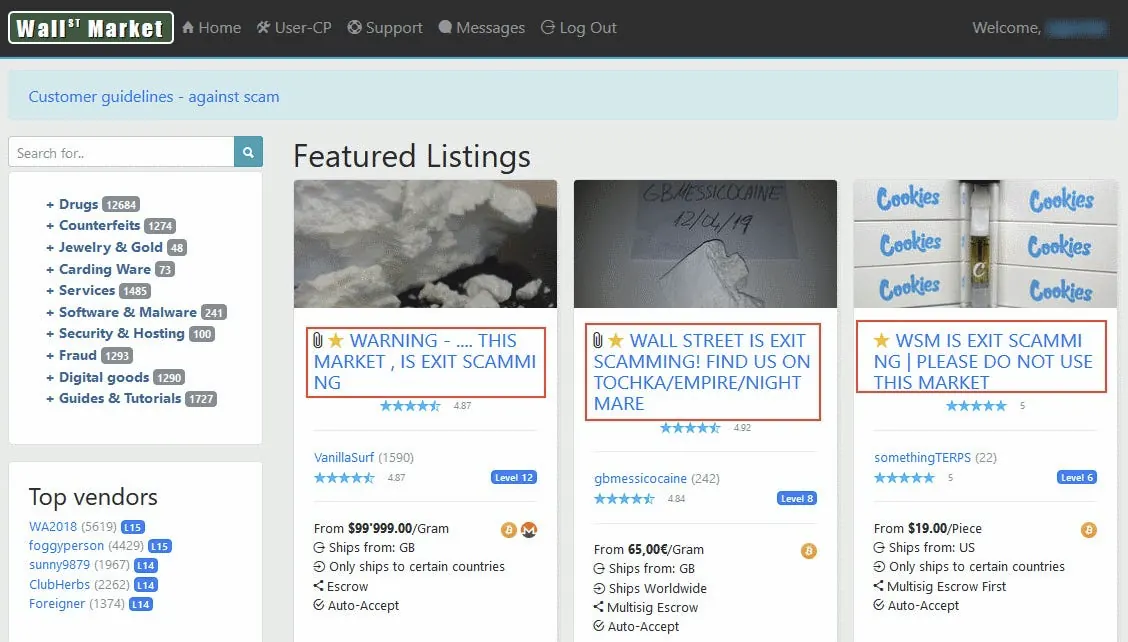
2019 was the year the exit scam became the defining way a market dies. Dream Market announced its own shutdown in March after roughly six years, pushing its vendors toward Wall Street Market. Wall Street Market then exit-scammed for around $11M, and a reused Bitcoin wallet on the transparent chain tied its admins to an earlier scam, helping put three of them in handcuffs within days. Churn cascades, and a reused wallet is forever.
2020–2021: Empire, Monopoly, and one clean exit
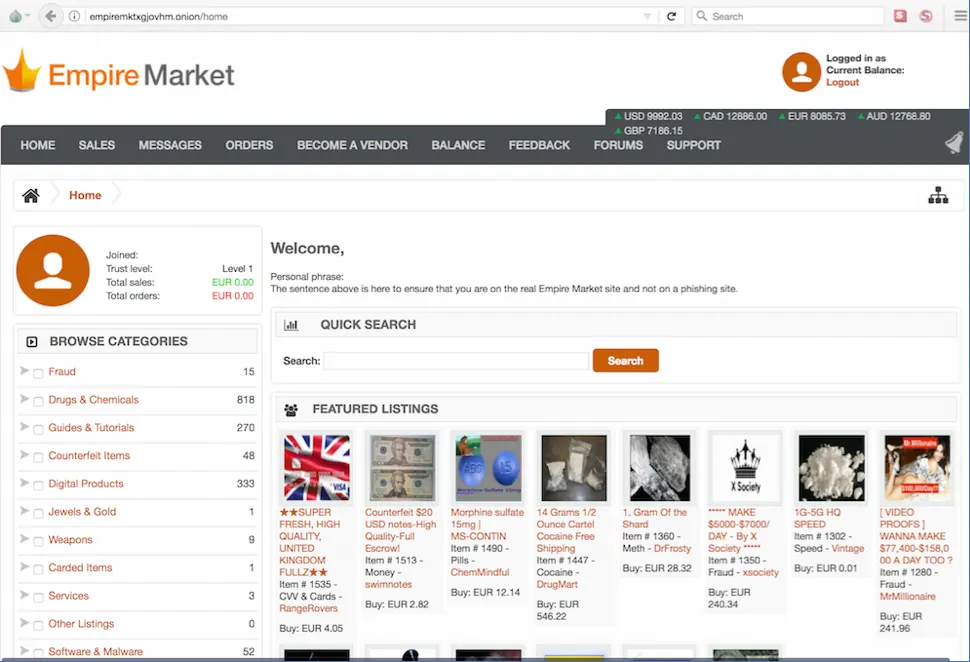
The early 2020s split markets into the ones that robbed their users and the ones that did not. Empire Market vanished in August 2020 with roughly $30M of escrow, using weeks of DDoS extortion as cover. Monopoly Market, by contrast, was secretly seized by German police in December 2021 and run silently to gather evidence for Operation SpecTor. Against both, White House Market stands alone: it retired voluntarily in October 2021 with a PGP-signed farewell, the exact verification it had told users to perform.
2022–2026: the takedown years
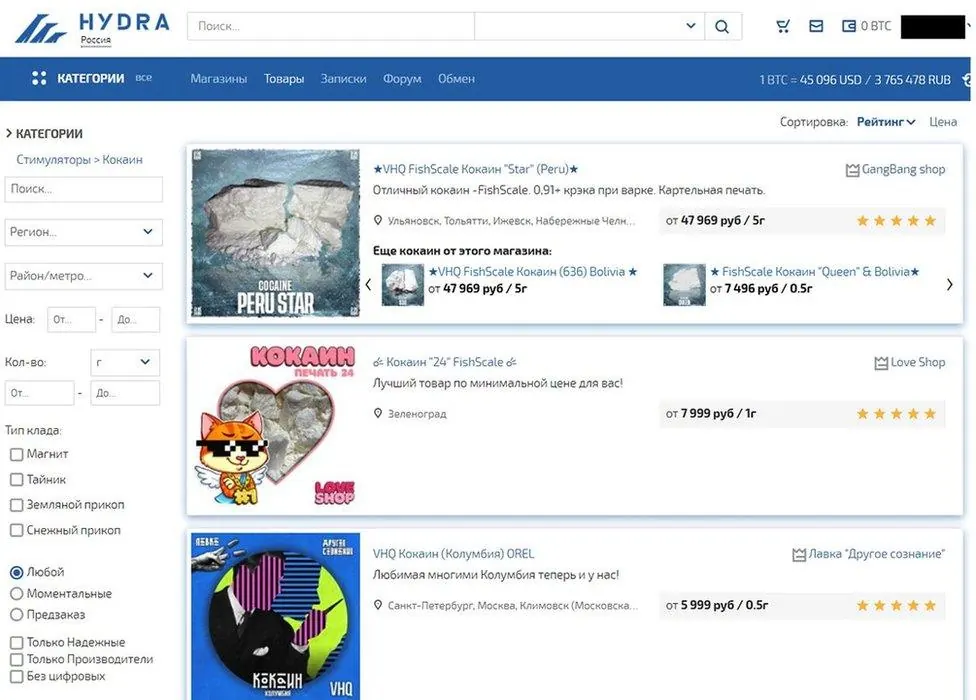
The most recent stretch has been defined by large, multinational seizures, most of them German-led. Hydra fell in April 2022 after roughly $5.2B in lifetime sales; Kingdom Market followed in December 2023, and Nemesis Market in March 2024. In 2025 the pace held: Archetyp was seized in June and Abacus exit-scammed in July, days apart in user experience but not in cause. The exit scams ran into 2026, when the anti-phishing-focused Kerberos Market vanished behind a "disk failure" excuse in February. The long-running Vice City Market belongs here too, its exit dated only loosely in the public record.
What this archive is for
This is not a museum; it is a risk model. Every market that is operating today, including the six in the directory of operating markets, will eventually appear on a page like this one, and the only open question is whether it goes by seizure or by scam. The markets that protected their users on the way out were the ones with a signed key and open withdrawals, which is why tordark teaches you to verify a signature rather than trust a reputation. Study how these ended, and the present gets easier to read.
For a broader overview, there are videos on this topic covering the most notable closed darknet markets of all time.
Common questions about historical darknet markets
What was the first darknet market?
Silk Road, launched in 2011 and seized by the FBI in 2013, is the market that proved the model: Tor for anonymity, Bitcoin held in escrow, and vendor reputations. Smaller predecessors like The Farmer's Market existed, but Silk Road was the first to combine those parts at scale, and its fall set the seizure-or-scam template every later market has followed.
What is the biggest darknet market in history?
By volume it is Hydra, by a wide margin. The Russian-language market handled roughly $5.2B in lifetime sales and an estimated 80% of all darknet cryptocurrency traffic before Germany's BKA seized it in April 2022. No Western market has come close: Abacus, briefly the largest English-language market in 2025, peaked at a small fraction of Hydra's scale.
What is the difference between a seizure and an exit scam?
A seizure is law enforcement taking a market's servers, usually announced with a banner that can appear days or even months after the site first goes dark. An exit scam is the operators draining escrow and disappearing. To a user the two look identical, because in both cases the site simply stops loading, and the only message that ever tells them apart is a PGP-signed one from the operators. White House Market is the single market in this archive that signed its goodbye.
Why do darknet markets keep getting shut down?
Two forces, working together. Operators make human mistakes, a reused wallet, a personal email, a misconfigured server, and Bitcoin's public ledger preserves each one for analysts to follow years later. Meanwhile takedowns have become standing multinational operations, most of them German-led, so an operator faces not one police force but a coalition. The markets that are not seized usually exit-scam instead, and either way the average lifespan is measured in months rather than years.
Are any of these historical darknet markets still accessible?
No. Every market documented on this page is closed. Any mirror or login page you find for one of them, whether Vice City, AlphaBay, Empire, or another, is a phishing clone standing on a dead brand to harvest credentials and coins. For markets that are genuinely operating now, see the verified directory, and trust an address only once it clears a signed canary.