 rdark
rdarkHansa Market: The Honeypot That Caught Thousands

The Hansa Market spent its last weeks as the most dangerous place on the dark web precisely because it looked like the safest. Dutch police had quietly seized it and were running it themselves, logging everything, while users fleeing AlphaBay flooded in believing they had found refuge. If you are searching for a Hansa link, the market has been gone since July 2017, and its story carries a warning sharper than any other in this archive: a site that loads, accepts your login, and processes your order can still be the trap. Here is how the honeypot was built, what it harvested, and why it changed how the dark web is policed.
What Hansa Market was
Hansa launched in 2015 as a Tor marketplace run by two German men, and by 2017 Europol ranked it the third-largest criminal market on the dark web, behind AlphaBay and Dream. It traded mostly in drugs, with malware and stolen data alongside, and notably barred weapons and child-abuse material. Its real selling point, though, was trust: Hansa was known for multisignature Bitcoin escrow, which held a buyer's funds in a way no single party could quietly empty, so customers felt protected from the exit scams that plagued rival markets.
That reputation for safety is the cruel hinge of the whole story. The very feature that drew users to Hansa, escrow that police could not simply seize, is the feature investigators would later sabotage from the inside once they held the keys. A market trusted because it could not rob you became a tool that could identify you, and most of its users never noticed the difference.
The covert takeover
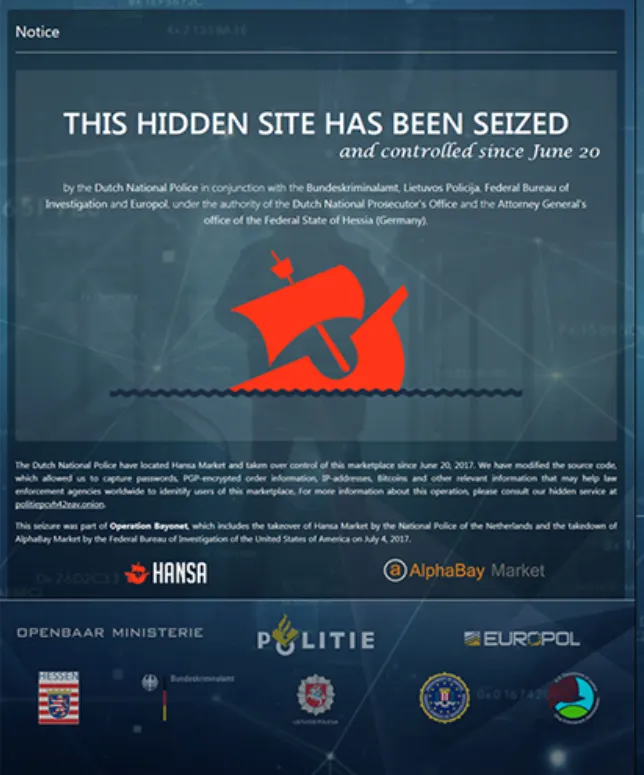
The trail began in 2016, when a tip-off led Dutch investigators to a Hansa server hosted in the Netherlands. That October they copied the server and rebuilt it on their own network, and digging through the administrator pages they found chat logs identifying two German nationals as the operators. The admins got spooked and moved their hosting, but a fresh break in April 2017 pinned the new servers down in Lithuania. On 20 June 2017, German police arrested the two men at their homes; they handed over their login credentials, and the Dutch National Police took complete control, migrated the servers to the Netherlands, and began impersonating the operators.
From the inside, the police rewired the market into a surveillance machine. They recorded every user's password in plaintext, useful for logging into other markets where people reused them; they modified Hansa's PGP convenience feature to keep a readable copy of each message before it was encrypted, which often captured a buyer's delivery address; and they altered the photo-upload tool so it secretly saved the location metadata it was meant to strip. They even tricked sellers into opening a file that beaconed their location. And because Hansa's multisig escrow was designed to resist seizure, they quietly disabled it so the coins could be taken. To every visitor, nothing had changed.
Absorbing the AlphaBay refugees
The honeypot's value multiplied the moment its twin fell. When the FBI seized AlphaBay in early July 2017 and let the outage look like ordinary downtime, its frightened users scattered to the market that felt safest, Hansa, exactly as police had planned. The surge was enormous: Europol recorded an eightfold jump in new members, and the site was so overwhelmed that the police-administrators had to temporarily close new registrations because the servers could not cope. For 27 days the Dutch ran the busiest drug market in Europe, logging roughly 27,000 transactions as evidence.
When they pulled the plug on 20 July 2017, during simultaneous press conferences in the Netherlands and the United States, the haul was staggering. Police came away with data on about 420,000 users, passed at least 10,000 foreign buyer addresses to Europol, flagged more than 500 Dutch delivery addresses so parcels could be intercepted, and seized roughly 1,200 bitcoin that the disabled multisig could no longer protect. Dozens of top vendors were arrested, and the chilling effect did the rest: many sellers quit the dark web or abandoned their identities, no longer sure which market was real and which was a trap.
Is there a Hansa Market link today?
No. Hansa was shut down on 20 July 2017 and has not existed since. Its case makes the usual warning literal: for the market's final month, the Hansa link resolved perfectly, the login worked, orders shipped, support replied, and all of it was run by police. If "the site still loads" was ever proof of safety, Hansa is the event that killed the idea.
Today the only thing left is the brand, and on the dark web a famous dead name is bait. Any "Hansa link," "Hansa URL," or mirror you come across is a phishing clone harvesting credentials and coins. Treat every one as hostile, enter nothing, and if you need a market that genuinely exists, verify a live one yourself with a PGP-signed canary rather than trusting how a page looks, the exact mistake Hansa's users made.
Where Hansa's users should look now
Hansa drew people with multisig escrow and the feeling of safety, so the right replacement is not just another market but a way of checking one. The markets operating now are tracked in tordark's verified directory, where general options like Nexus and TorZon cover the broad catalogue Hansa once did. If escrow design is what reassured you, our guide to escrow and multisig explains what real protection looks like, and where it quietly fails.
But take the deeper lesson with you. Hansa proves that a friendly, fully working market can be the most dangerous one of all, so the only defence that survives a honeypot is cryptographic. Confirm the operator's signed canary rather than trusting the interface, and keep nothing in escrow beyond an open trade, because you can never be certain who is holding the keys.
Why a working market can be the trap
Hansa is the clearest proof that a market being operational can mean someone is watching, not that anyone is safe. A site run by police is indistinguishable from a healthy one until it is far too late, and the same ambiguity recurred when Monopoly Market was silently seized and run by German authorities in 2021. Uptime, a smooth interface, and even genuine buyer-protection features are not verification; they are exactly what a honeypot copies first.
The operation also signalled a strategic shift that still defines dark-web policing. Rather than simply taking a market down, investigators now consider taking it over, because a takeover yields what a takedown cannot: the users. For anyone weighing a market today, that makes the takeaway permanent, treat reachability as meaningless, read the wider pattern across the archive of closures, and put your trust only in a signature you verified, never in a login screen that loads.
Common questions about the Hansa honeypot
Is there a working Hansa Market link?
No. Hansa was shut down on 20 July 2017 and has never returned. There is a darker twist, too: for its final month the Hansa link did resolve and looked completely normal, because the Dutch police were running it as a trap. Any "Hansa link," mirror, or URL you find today is a phishing clone built on the name. Do not enter credentials or send funds to it; verify a live alternative instead.
What happened to Hansa Market?
Dutch police secretly took control of it. After arresting its two German administrators on 20 June 2017 and seizing the servers, the Dutch National Police impersonated the operators and ran Hansa as a honeypot for 27 days. They timed it with the FBI's takedown of AlphaBay so fleeing AlphaBay users would pour into Hansa, then shut it down publicly on 20 July 2017.
What is a honeypot, and how did Hansa become one?
A honeypot is a service that looks legitimate but is run by investigators to gather evidence. Hansa became one when police seized its servers and the administrators' login credentials, then rewrote the site's code to record every password in plaintext, log PGP messages before they were encrypted, strip-but-save photo metadata for geolocation, and disable the multisig that had protected user funds.
How many people did the Hansa sting catch?
A lot. Police gathered data on roughly 420,000 users, passed at least 10,000 foreign buyer addresses to Europol, flagged more than 500 Dutch delivery addresses to halt parcels, and seized around 1,200 bitcoin. Dozens of the market's top vendors were arrested, and the operation spooked much of the vendor base into quitting or changing identities.
Was Hansa part of Operation Bayonet?
Yes. Operation Bayonet had two coordinated halves: the FBI-led seizure of AlphaBay and the Dutch-led takeover of Hansa. The sequence was the weapon, AlphaBay was shut down loudly so its users would flee to Hansa exactly while police controlled it, turning an ordinary outage into a trap.
What can I use instead of Hansa Market?
Only a market whose current address you can verify against a PGP-signed canary, because Hansa proved that a working, friendly-looking site can be the trap itself. The markets operating now are tracked in tordark's verified directory. Confirm the operator's signature rather than trusting the interface, and treat anything using the Hansa name as hostile.