 rdark
rdarkHydra Market: The $5 Billion Russian Giant
Hydra was the largest darknet market the world has ever seen, and the only one whose name turned out to be a prophecy. For seven years it dominated the Russian-language dark web at a scale no Western market ever approached, roughly $5.2 billion in sales and 17 million accounts, running drugs not by mail but by buried "treasure" drops across the former Soviet Union. German police cut off its head in April 2022. If you are searching for a Hydra link, that head never grew back, but a dozen others did. This is how Hydra worked, how it fell, and why the markets that replaced it make verification matter more than ever.
How big was Hydra Market?
Hydra operated on a scale that puts every other market in this archive in perspective. By the time it was seized it accounted for an estimated 80% of all darknet cryptocurrency volume, with around 17 million customer accounts and more than 19,000 seller accounts. Lifetime sales since 2016 reached roughly $5.2 billion, and in 2020 alone its revenue topped €1.23 billion. A market that large is not a forum; it is financial infrastructure for an entire criminal economy.
It was also distinctly Russian. Launched in 2015 from a merger of two older sites, WayAway and LegalRC, Hydra was written in Russian and served sellers and buyers across Russia, Ukraine, Belarus, Kazakhstan, and neighbouring states. When its Russian-language predecessor RAMP was shut down by Russian police in 2017, Hydra was left to grow almost unchallenged at home, because Russian law enforcement never moved against it directly. It sold the usual catalogue, drugs above all, plus stolen data, forged documents, and digital services, and it ran a built-in "Bitcoin Bank Mixer" to launder the proceeds, a feature that quietly conceded how traceable plain Bitcoin really is.
The dead-drop "klad" model that set Hydra apart
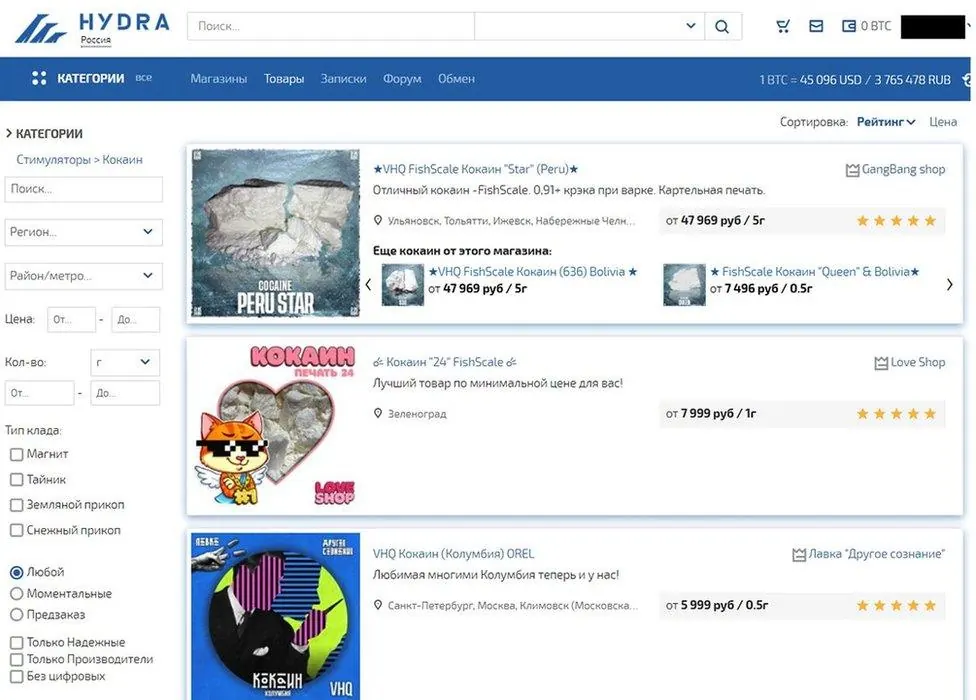
The single feature that separated Hydra from AlphaBay, Silk Road, and every Western market was how the drugs actually moved. Western markets mail orders through the post; Hydra used the dead-drop, known in Russian as "klad" (клад), meaning "treasure." A vendor's courier would hide a package somewhere public, a park, a stairwell, a patch of earth, and once the buyer paid, the platform handed over the coordinates and a photo of the hiding spot. The buyer simply went and dug it up.
That model has two consequences worth understanding. It keeps the goods out of the postal system entirely, removing the customs and mail-interception choke points that catch Western buyers, but the courier costs are steep, sometimes more than half a drug's price. And because a courier can only service the area they physically cover, the dead-drop binds each vendor to a city or region. Hydra was therefore not one international bazaar but a dense network of local markets stitched together under one brand, which is part of why it embedded so deeply into everyday life across Russia and why its successors inherited the same geography.
How Hydra Market was seized in 2022
On 5 April 2022, Germany's Federal Criminal Police Office (BKA) and the Frankfurt cybercrime prosecutor (ZIT) seized Hydra's German server infrastructure and shut the market down, capping an investigation that had run since August 2021 with several US agencies, the DOJ, FBI, DEA, IRS-CI, and HSI, alongside. The servers were traced to a bullet-proof hosting company on German soil, and investigators confiscated 543 bitcoin, worth about €23 million or $25 million at the time.
The same day, US prosecutors in San Francisco indicted Dmitry Olegovich Pavlov, a Russian national alleged to have run Hydra's infrastructure through his company Promservice, and the US Treasury's OFAC sanctioned both Hydra and the Russia-based exchange Garantex, which had helped cash out its proceeds. The takedown was as much a financial strike as a technical one, but it had a hard limit: Pavlov is in Russia, beyond the reach of extradition, so the servers fell while the man did not. It took German and American agencies to end a market Russian police had left alone for years.
Cutting one head: the markets that replaced Hydra
Hydra's name came back to haunt the takedown. In the myth, cutting off one of the Hydra's heads makes two grow in its place, and that is almost exactly what happened. Within months of the seizure, a wave of Russian-language successors filled the vacuum, what analysts called a "Cambrian explosion" of new markets, and collectively they soon surpassed Hydra's own volume. By the end of 2022, Russian-language markets accounted for over 80% of all darknet deposits, the share Hydra had held alone.
The biggest of the new heads are Mega, Blacksprut, OMG!OMG!, and above all Kraken, which billed itself as Hydra's true successor and is widely believed to be run by former Hydra staff; in January 2023 it even hostile-took-over a rival market, Solaris. They use the same dead-drop model and serve the same regions, and they have proven far more durable than Western markets. None of them is verified by tordark, and none should be trusted on the strength of the Hydra lineage they advertise, that lineage is a marketing claim, not a guarantee of safety.
Is there a Hydra Market link?
No. Hydra was seized on 5 April 2022 and its homepage replaced by a police banner; there is no genuine Hydra address, and there will not be one. As the most famous name the Russian-language dark web ever produced, "Hydra" is now prime bait. Any "Hydra link," "Hydra onion," or mirror you find is a phishing clone, or a successor market borrowing the brand's prestige, and in both cases you have no way to know who is on the other end.
Treat every Hydra address as hostile, enter nothing, and send nothing. The successors that claim Hydra's mantle are unverified and carry exactly the risks Hydra did, including the chance that the next one has already been quietly seized. If you need a market that genuinely operates, verify a live one yourself with a PGP-signed canary rather than trusting a name, however legendary.
Safer alternatives to Hydra
An honest caveat first: Hydra was a Russian-language, dead-drop market, and the markets tordark tracks are Western, mail-based operations, so there is no like-for-like replacement, and the Russian successors above are not verified here. What tordark can offer is the only thing that ever mattered, a market whose current address you can actually confirm. Those are listed in the verified darknet market directory, where options like Nexus and TorZon are checked against a signature rather than a reputation.
Hydra also makes the payment lesson concrete. It ran a built-in Bitcoin mixer precisely because plain Bitcoin is so readable to investigators, an admission in code that the coin it accepted was a liability. The markets that take privacy seriously now settle in Monero, whose ledger needs no mixer because it cannot be read that way; DrugHub and DarkMatter are reported to refuse Bitcoin outright. Whatever you weigh, confirm the address against a signed canary and keep nothing in escrow beyond an open trade.
Common questions about Hydra Market
Is there a working Hydra Market link?
No. Hydra was seized by German authorities on 5 April 2022, its servers taken and its homepage replaced by a police banner. There is no genuine Hydra address anymore, so any "Hydra link," mirror, or onion URL is a phishing clone trading on the most famous name in the Russian-language dark web. Do not enter credentials or send funds to it; verify a live alternative instead.
What happened to Hydra Market?
Germany's BKA and the Frankfurt cybercrime prosecutor (ZIT), working with several US agencies, seized Hydra's German server infrastructure on 5 April 2022 and confiscated 543 bitcoin, worth about $25 million. The US simultaneously indicted alleged administrator Dmitry Pavlov and sanctioned both Hydra and the Garantex exchange. The investigation had run since August 2021.
How big was Hydra Market?
It was the largest darknet market in history. Hydra accounted for an estimated 80% of all darknet cryptocurrency volume, with about 17 million customer accounts and more than 19,000 seller accounts, and roughly $5.2 billion in sales between 2016 and its 2022 seizure. In 2020 alone its revenue topped €1.23 billion.
What was Hydra's dead-drop (klad) system?
Instead of mailing drugs like Western markets, Hydra used "klad" (Russian for "treasure"): a courier buried or hid a package in a public place, and after payment the buyer received the coordinates and a photo of the stash. It kept goods out of the postal system entirely, but it tied each vendor to a geographic area, so Hydra worked as a network of local markets rather than an international one.
Who ran Hydra Market?
US prosecutors charged Dmitry Olegovich Pavlov, a Russian national in his early thirties, alleging he ran the servers behind Hydra through his hosting company, Promservice. Because he is in Russia, he remains beyond the reach of US or German extradition. Hydra had earlier grown out of a 2015 merger of two older sites, WayAway and LegalRC.
What replaced Hydra Market?
A wave of Russian-language successors, most notably Mega, Kraken (widely believed to be run by former Hydra staff), Blacksprut, and OMG!OMG!. Within months they had collectively surpassed Hydra's volume. tordark does not verify these markets; they carry the same risks Hydra did, and any address for them must be confirmed against a PGP-signed canary before it is trusted.