 rdark
rdarkKerberos Market: The Guardian That Robbed Its Own Users
Kerberos took its name from the three-headed hound that guards the gates of the underworld, and guarding was its whole pitch. Among the markets of its era it stood out for anti-phishing: a signed mirror list, blunt "don't get phished" warnings, and tools built to keep users off the clones that prey on the dark web. On that one narrow problem, it worked. What it never protected users from was the people running it. In February 2026, after roughly four years online, Kerberos simply vanished behind a "disk failure" excuse and took its users' funds with it, a textbook exit scam. If you are searching for a Kerberos Market link, there is no safe one left, and the market's own anti-phishing rule is the proof. This is what Kerberos was, how it guarded its users, and how it robbed them anyway.
Is the Kerberos Market link still live?
No. Kerberos disappeared in February 2026 and has not come back; its onion addresses, and even the backend behind them, went dark, and the operators never reappeared. There is a fitting irony in how certain you can be of this: Kerberos itself drilled into users that the only trustworthy link is one confirmed against its PGP-signed mirror list. With the market gone and its operators vanished, no current signed list exists, so by Kerberos's own standard every "Kerberos link," mirror, or onion URL circulating now fails the test.
Treat all of them as hostile, enter nothing, and send nothing. A login page that looks right is exactly what Kerberos taught you to distrust, a clone betting you will not check, except there is no longer any genuine signature behind the name to check against. If you need a market that actually operates, verify a live one against its own current PGP-signed canary, starting from the alternatives below.
What Kerberos Market was, and what it promised
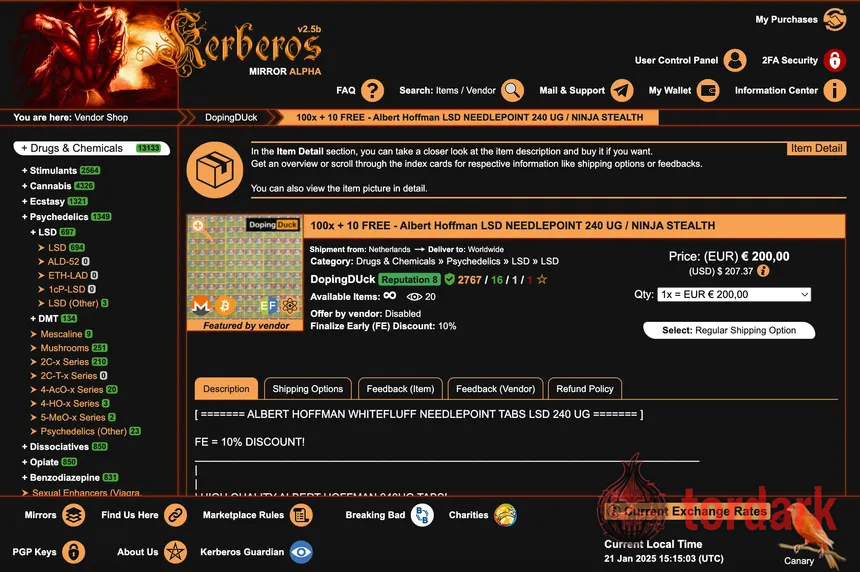
Kerberos launched in early 2022 and grew into a moderately sized market with thousands of users and thousands of listings, trading the usual dark-web catalogue, drugs above all, with stolen logins alongside, and settling in Bitcoin and Monero. Mechanically it was conventional: a 2-of-3 multisignature escrow held a buyer's funds so no single party could quietly drain them, PGP secured messages, and a canary signalled the operators' status. Its personality was anything but conventional, leaning hard into a medieval, "guardian of the underworld" aesthetic built around its three-headed-hound namesake.
What set Kerberos apart was how loudly it advertised user protection. As the storefront shows, "Mirrors," "PGP Keys," a "Canary," and a "Kerberos Guardian" all sit right in the navigation rather than buried in a help page. The market sold itself as the thing standing between a user and the dark web's scammers, which is exactly what makes its ending so pointed.
Kerberos's anti-phishing defenses
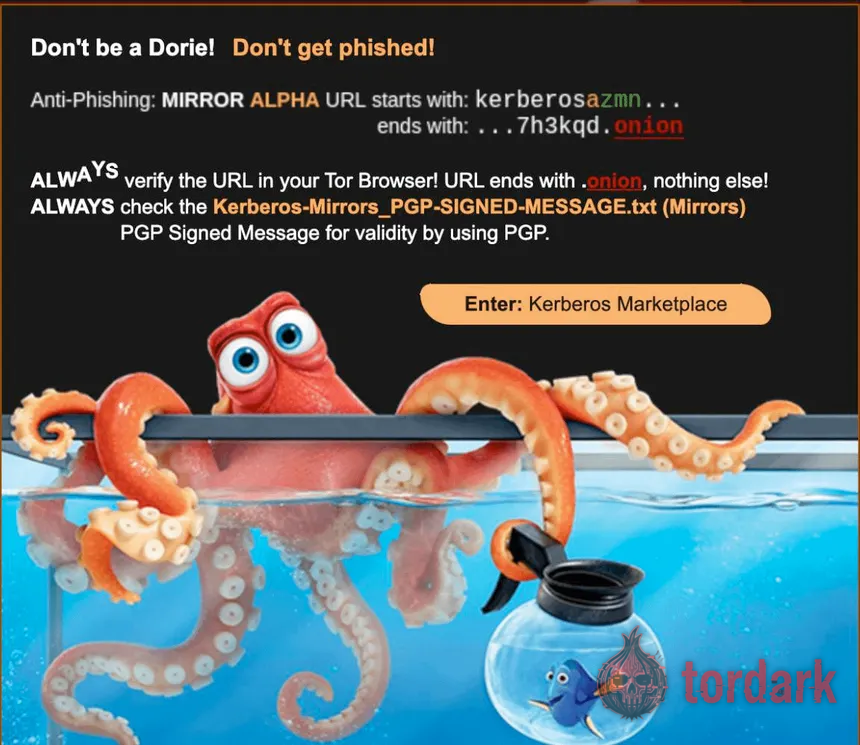
Phishing is the oldest and most effective attack on the dark web: a clone copies a market's look and all but a couple of characters of its onion address, then harvests the credentials and coins of anyone who does not check. Kerberos treated that as a first-class problem. Its anti-phishing splash was blunt enough to stick, telling users to confirm the start and end of the onion URL against the known address and to trust no link that did not match.
The backbone was a PGP-signed mirror list: Kerberos published its real addresses inside a message signed with the market's private key, so a user could verify the signature and know the links were genuine, the same cryptographic check tordark urges everywhere. An attacker can copy a storefront pixel for pixel but cannot forge that signature without the operators' key. On the narrow question of telling a real Kerberos from a fake one, this genuinely worked. The problem, it turned out, was never the fakes.
Sketchy from the start, gone in 2026

For all its polish, Kerberos was distrusted by much of the community from the beginning, and the reasons were technical. The market was built on the Eckmar script, an off-the-shelf marketplace framework that lets an operator stand up escrow and listings with little development effort. That alone is unremarkable, plenty of markets use templates, but as Dread's HugBunter pointed out, the Eckmar script network has been associated with phishing and is hawked by people falsely impersonating him. A market whose entire pitch was anti-phishing, built on a framework dogged by phishing, was a contradiction some users never got past.
They were right to worry, though not in the way most expected. In early February 2026, Kerberos's administrators announced that a disk failure had knocked the site temporarily offline. By mid-February the onion addresses, and the backend behind them, were completely gone, with no further word and no sign of the operators since. The community read it immediately, and correctly, as an exit scam, the second major one of 2026 after La Palida. The "disk failure" did exactly what Empire's "DDoS" and Abacus's "DDoS" did before it: bought a few quiet days to drain the escrow while users assumed the outage was temporary. The guardian against clones turned out to be the thief.
Where to go now that Kerberos is gone
If Kerberos's appeal was its security culture, the right replacement is not another market that talks about safety, but one whose address you can actually verify, the very habit Kerberos tried to instill. The markets operating now are tracked in tordark's verified darknet market directory, each shown beside the PGP-signed canary that confirms its address; general-purpose options like Nexus and TorZon cover the catalogue Kerberos did.
Carry Kerberos's lesson forward with one correction. Its anti-phishing tooling was real, but it guards only half the danger: a verified, signed address still leads to operators who can rob you outright. So verify the address every visit and keep your exposure small, prefer Monero settlement, with DrugHub and DarkMatter reported to refuse Bitcoin, confirm the current address against a signed canary, and never leave more in escrow than a live trade needs. The funds a market cannot drain are the ones you never deposited in advance.
Why the anti-phishing was beside the point
Kerberos draws a clean line between two threats that are easy to confuse. Anti-phishing protects you from someone else impersonating a market; it does nothing to protect you from the market itself. Kerberos guarded the first threat about as well as anyone on the dark web and was undone by the second, robbing the very users it promised to shield. A signed mirror list proves you have reached the real operators; it cannot prove the real operators are honest, and an exit scam is simply the genuine market, signature and all, keeping your money. That is the distinction running through this whole archive: verification tells you who you are dealing with, not whether to trust them. Read the same cover-story playbook in the Empire and Abacus case studies, learn the warning signs in our guide to exit scams, and weigh anything in today's directory with this in mind.
Common questions about the Kerberos exit scam
Is there a working Kerberos Market link?
No. Kerberos disappeared in a suspected exit scam in February 2026; its onion addresses and backend went offline and the operators never returned. There is no genuine Kerberos address anymore, so any "Kerberos link," mirror, or onion URL is a phishing clone. Fittingly, Kerberos itself taught users to trust only a link confirmed against its PGP-signed mirror list, and with the market gone no such signed list exists, so every Kerberos link now fails its own test. Verify a live alternative instead.
What happened to Kerberos Market?
It exit-scammed in February 2026. In early February its administrators blamed a "disk failure" for the site being temporarily inaccessible; by mid-February the onion addresses and the backend behind them were completely offline, with no further word and no sign of the operators since. The community judged it an exit scam, the second major one of 2026 after La Palida.
When did Kerberos Market launch and close?
Kerberos first appeared in early 2022 and grew into a moderately sized market with thousands of users and listings. It operated for roughly four years before vanishing in a suspected exit scam in February 2026.
Was Kerberos Market trustworthy?
Much of the community doubted it from the outset. It was built on the Eckmar script, an off-the-shelf marketplace framework that, as Dread's HugBunter noted, has been associated with phishing and is hawked by people falsely impersonating him. Despite heavy anti-phishing features in its interface, Kerberos ultimately robbed its own users, which settled the question.
What was Kerberos's anti-phishing protection?
Kerberos published a PGP-signed mirror list (its real .onion addresses inside a message signed with the market's key) and ran a blunt anti-phishing splash telling users to verify the start and end of the URL and to check that signed list. It also surfaced "Mirrors," "PGP Keys," a canary, and a "Kerberos Guardian" directly in its navigation. The tooling worked against clones; it could not protect users from the operators themselves.
What can I use instead of Kerberos Market?
Only a market whose current address you can verify against a PGP-signed canary. The markets operating now are tracked in tordark's verified directory. Confirm the signature first, prefer Monero settlement, keep nothing in escrow beyond a live trade, and treat anything bearing the Kerberos name as a trap.