 rdark
Nexus Market URL: Exit Scam & Why Every Link Is a Clone

If you are searching for a Nexus market url, the search ends on 2 October 2026. Nexus was one of the higher-profile general-purpose Western markets of the post-Hydra era — a reported ~40,000 listings, a physical/digital mode switch, an Autoshop for instant digital delivery, and three-coin payments through a built-in wallet — and it vanished behind stalled withdrawals and dead mirrors with no seizure banner and no signed farewell. What follows is what Nexus was, why its most distinctive feature makes every post-closure link more dangerous than a typical dead-market mirror, and where the catalogue it carried might still be found.
Is the Nexus link still working?
No. Nexus stopped loading on 2 October 2026 and has not returned; its v3 mirrors went dark and the operators never reappeared with a signed mirror list or an explanation. There is no genuine Nexus onion address anymore — only the name, and on the dark web a recognisable dead brand is bait.
That matters more for Nexus than for most closed markets because Nexus trained its users to expect a polished, multi-mirror setup and an instant-checkout Autoshop. A login page that looks exactly right is what Nexus's own interface taught people to trust; after 2 October there is no signature behind the name to distinguish the real thing from a copy, because the real thing no longer exists. Enter nothing, deposit nothing, and treat every "Nexus mirror" as hostile.
What Nexus was
Nexus launched in 2023 and grew into one of the larger general-purpose Western markets, trading the usual dark-web catalogue with Bitcoin, Monero and Litecoin settlement and traditional escrow with early finalization for trusted vendors. Mechanically it was conventional; cosmetically it pitched itself as a "next generation" platform and largely delivered — which is why its interface became one of the most reproduced on the dark web.
| Launched | 2023 |
|---|---|
| Closed | 2 October 2026 (exit scam, suspected) |
| Listings (reported) | ~40,000 |
| Payment | Bitcoin, Monero, Litecoin; built-in wallet or direct |
| Escrow | Traditional escrow, early finalization for trusted vendors |
| Distinctive features | Physical/digital mode switch, Autoshop, shopping cart |
| Account security | Optional PGP and 2FA; withdrawal PIN; mnemonic recovery key |
The Autoshop trap
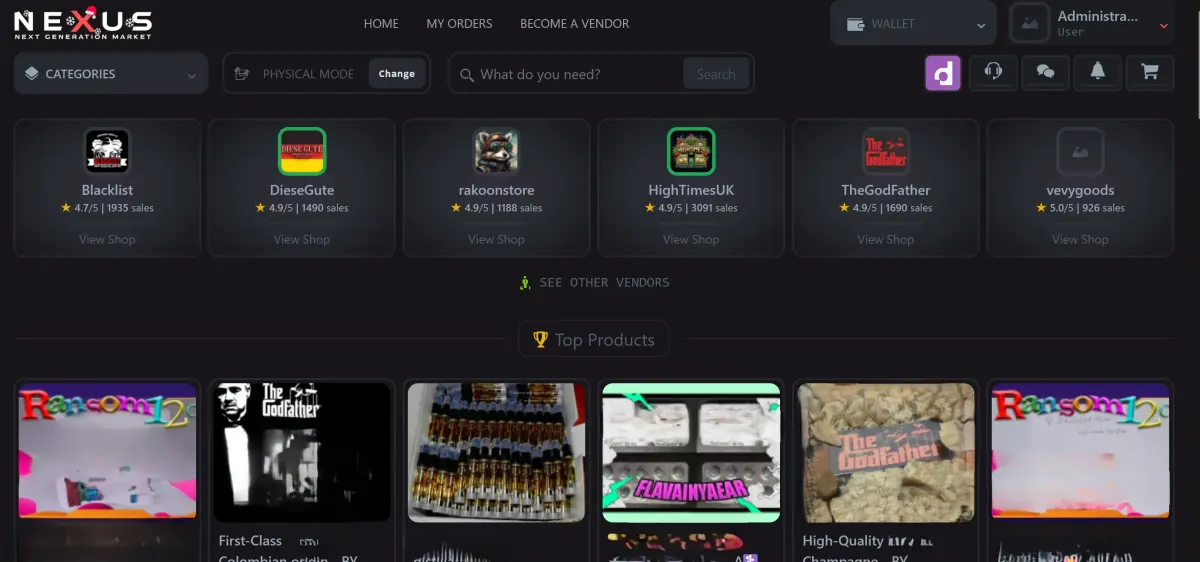
Nexus's Autoshop was a built-in storefront for digital goods: vendors pre-loaded their items, and the platform delivered them automatically the moment a buyer paid — no human had to send anything, no waiting period, no vendor online. For genuine digital products on the real market, that immediacy was the selling point.
On a phishing clone, the same flow is a coin trap with no recovery. A conventional escrow dispute assumes a market backend someone is still answering; an Autoshop payment on a fake page simply takes your funds and returns nothing, instantly, with no human in the loop to argue with. Nexus made that pattern familiar to tens of thousands of users, which is why a post-closure "Nexus link" that still offers Autoshop checkout is among the fastest ways to lose a balance on a dead brand.
Physical and digital modes
Nexus split its home screen into a physical side and a digital side — drugs and physical-goods categories kept apart from digital listings so a large catalogue stayed navigable. It was a small interface decision that made a ~40,000-listing market feel manageable, paired with a category dropdown and a search bar on every page.
Clones copied that split because users expected it. "It has the physical/digital toggle" is not evidence you are on Nexus; it is evidence you are on a page built by someone who knows what Nexus looked like. After October 2026 the only question worth asking about any Nexus address is whether a current operator signed for it — and none will.
Mnemonic, PIN and the phishing surface
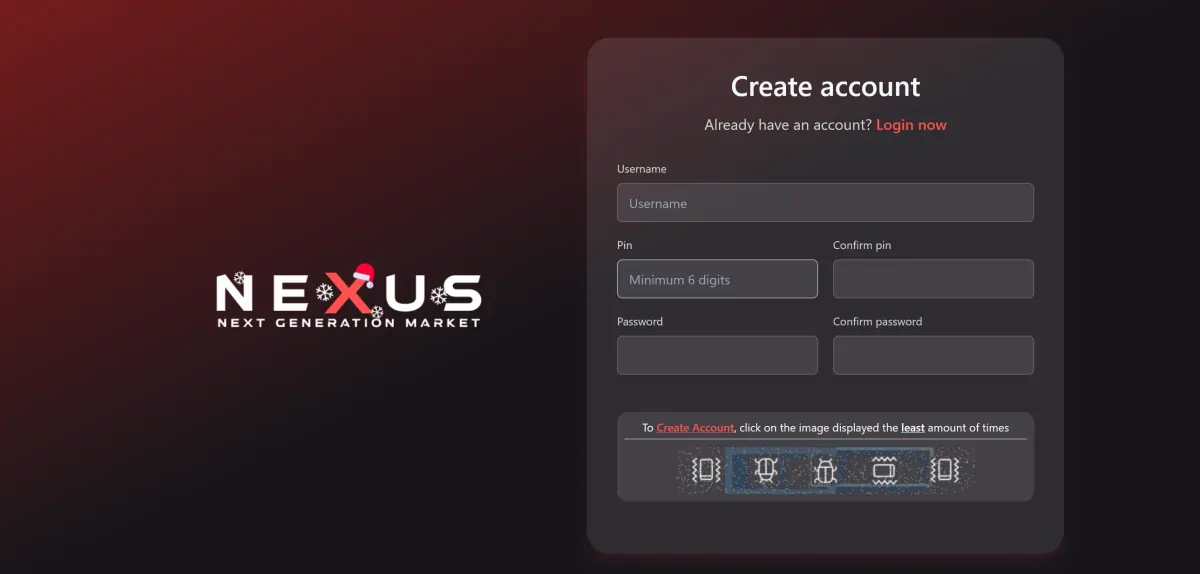
Nexus's account model was heavier than a username and password. At registration you set a withdrawal PIN — a second gate so a stolen login alone could not move funds — and received a unique mnemonic phrase for account recovery. PGP and 2FA were available but optional.
That mnemonic is why "Nexus account recovery" searches are dangerous after the closure. Phishing crews stand up recovery and login pages for dead markets precisely to capture phrases and PINs from users who believe the market might come back. With Nexus gone, there is no account to recover on the real service — only a form designed to steal credentials you once used.
How Nexus ended

The end followed a pattern the closed-market archive documents often enough to recognise. Users on Dread reported withdrawals slowing and then stopping; the mirrors went offline on 2 October 2026; no law-enforcement seizure page appeared; the operators did not publish a PGP-signed statement. Empire used a DDoS excuse in 2020 before draining roughly $30M — Nexus offered no even that much theatre.
DarkMatter had exit-scammed five days earlier on 27 September, so Nexus's disappearance landed in an already unsettled Western market. Refugees from both names will concentrate wherever volume goes next, and so will the clones wearing their brands.
Where to go now
Nexus's draw was breadth — a general-purpose catalogue with multiple payment options and a modern interface. The markets still operating are listed in tordark's verified directory; for catalogue size and payment flexibility, TorZon is the closest match, reported to take Bitcoin and Monero on mirrors that rotate frequently enough that last week's address may already be wrong. For Monero-only settlement with dated analyst reporting behind the name, DrugHub is the other obvious port of call.
Neither is "the new Nexus," and treating any market as a guaranteed successor is how phishing directories catch refugees. Run the check in our PGP verification guide on every visit, prefer Monero where you can, and keep nothing in a built-in wallet beyond what an open order needs — Nexus's pooled-wallet model was exactly what an exit drains.
Common questions about Nexus
Is there a working Nexus market url?
No. Nexus went offline on 2 October 2026 in a suspected exit scam; its mirrors stopped resolving and the operators never published a signed statement. Any Nexus onion address, mirror list or login page you find now is a phishing clone — and Nexus's Autoshop means a convincing fake can take payment instantly with no dispute window.
What happened to Nexus Market?
Withdrawal complaints on Dread preceded a full outage on 2 October 2026. No law-enforcement banner appeared, and unlike White House Market in 2021 there was no PGP-signed goodbye. The community judged it an exit scam — the third major Western disappearance of 2026 after Kerberos and DarkMatter.
What was the Nexus Autoshop?
A built-in storefront where vendors pre-loaded digital goods and the platform delivered them automatically the moment you paid — no vendor had to send anything manually. On the real Nexus that was convenience; on a clone it is an instant coin grab with nothing to dispute.
Why are Nexus clones especially dangerous?
Nexus was one of the most copied interfaces on the dark web: a clean layout, a physical/digital mode switch, and an Autoshop that trained users to pay and expect instant delivery. A clone reproduces all of that; the only thing it cannot reproduce is the operator's private key behind a signed canary — and with Nexus gone, no current canary exists anyway.
What can I use instead of Nexus?
For the broad catalogue Nexus carried, TorZon is the closest general-purpose option still in tordark's verified directory. For Monero-only settlement, DrugHub is the name with dated analyst reporting behind it. Confirm whichever address you choose against a PGP-signed canary before you use it.
Was Nexus a scam before it closed?
Nothing in the public record tied Nexus to a seizure or exit scam before October 2026, which is precisely the trap: Empire kept a glowing reputation until the morning it vanished with roughly $30M. A clean run through 2023–2026 is a status, not a guarantee — and the October outage settled the question.