 rdark
rdarkDark Matter Market URL: Verified Onion Link & Mirrors

The Dark Matter market url is unusual in two ways that matter before you go looking for it. First, Dark Matter takes no Bitcoin, so there is no deposit address to cross-check and the onion signature alone proves identity. Second, it runs on direct payments with no built-in wallet, which removes the pooled balance an exit scammer would normally empty. Launched around 2022 and grown to a reported 95,000 users and 26,000 listings, it has stayed deliberately plain, almost archaic, where rivals chase modern interfaces. tordark covers it from the outside, with no affiliation and no interest in whether you reach it. This page records the addresses currently tracked, explains the design and payment choices that set it apart, and shows how to confirm a Dark Matter link.
These are the Dark Matter onion addresses tordark tracks as of June 2026. The market rotates a small set of mirrors for resilience, so expect changes, and expect clones, which on a Bitcoin-free market are especially dangerous because there is no on-chain trail to expose a wrong address after the fact. Match any address against Dark Matter's PGP-signed canary before you use it.
darkmatgvwajlcq75r6dpighmbac77gd5nqgujxq3mrdavyl46pcf3id.onion darkmatj7cjqruicuemre5svpnyfwjwgv5brvvv25hhwifagd4pkafyd.oniondarkmativnommp4jfudokuaimdpmvwo3ac2zhdkrw3vjfi4dj6yuy6ad.onion
Dark Matter at a glance
Reported figures, useful for scale rather than for trust. The number worth weighing is not the user count but the years: a market that has run roughly three years without a documented exit is rarer than its size suggests.
| Launched | ~2022 |
|---|---|
| Registered users | 95,000+ (reported) |
| Active listings | 26,000+ (reported) |
| Payment model | Direct payment, no built-in wallet |
| Coins | Monero default; Litecoin and Zcash claimed, vendor-dependent; no Bitcoin |
| Escrow | Escrow on all orders, optional multisignature |
| Security | Phishing-proof captcha; optional PGP, 2FA, and OTP authenticator mode |
The deliberately old-fashioned interface
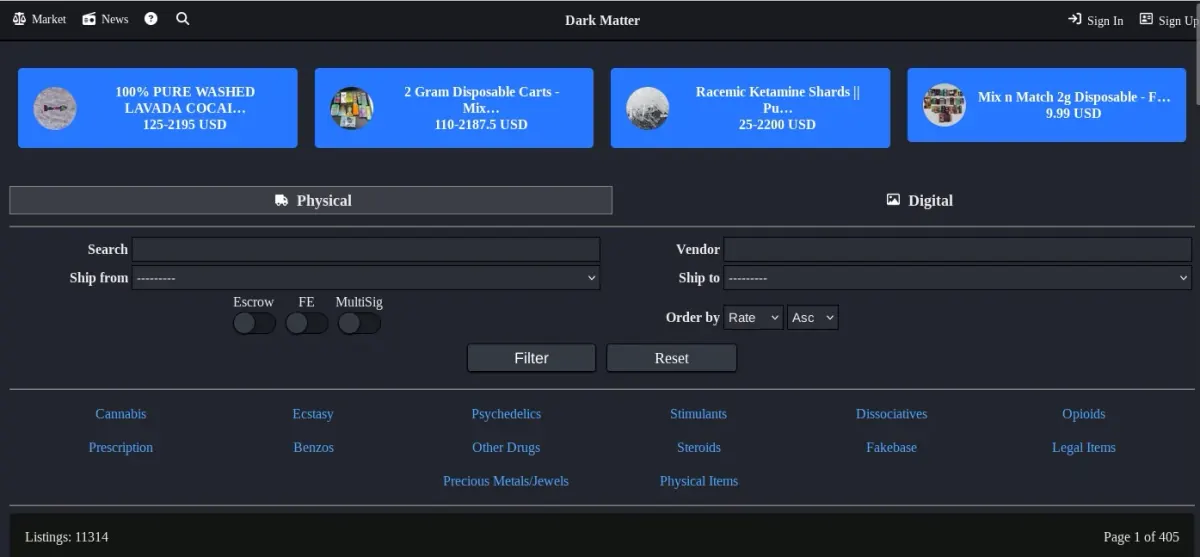
Dark Matter looks like a darknet market from a decade ago, and that is on purpose. Where newer rivals lead with polished, image-heavy interfaces, Dark Matter keeps a minimal, almost archaic front end that long-time users tend to appreciate: it is quick to learn, light to load over a slow Tor circuit, and offers a smaller attack surface than a page stuffed with scripts and graphics. The plainness is a usability decision dressed as nostalgia, and it pairs naturally with the market's JavaScript-light posture and its phishing-proof captcha. The one thing the look does not tell you is whether you are on the real market. A clone can reproduce a spartan interface even more easily than a fancy one, precisely because there is less to copy, so the aesthetic is a preference, never a proof.
Direct payments and optional multisig
The most consequential thing about Dark Matter is how it handles money, and it is genuinely different from most of this directory. There is no proprietary wallet to pre-load: payments are direct, made to the trade rather than into a balance the market holds on its servers. That single choice removes the pooled deposit wallet that is the classic exit-scam mechanism, the one Empire emptied for roughly $30M in 2020, because there is no large communal pot for an operator to walk off with. On top of that, every order is held in escrow, with optional multisignature support, the strongest arrangement available, where releasing funds requires more than one party's key so no single actor can move money alone.
This is the closest a darknet market gets to a structurally honest design, and it is worth seeking out the multisig option where a vendor offers it. It is not a force field. Direct payment can still send coins to a clone if you funded the wrong address, multisig only protects a trade once you are demonstrably on the real market, and escrow of any kind ends the moment the market itself vanishes. The payment model lowers one specific risk, the mass exit scam, and leaves the verification problem exactly where it was.
Which coins Dark Matter takes
Monero is the default and, for anyone weighing privacy, the right one: its ring signatures and stealth addresses are built to defeat the chain analysis that Bitcoin's public ledger invites, and our guide to acquiring Monero covers getting it without rebuilding the trail you are avoiding. Dark Matter also claims Litecoin and Zcash support, but the choice is vendor-dependent and XMR remains the standard, so in practice Monero is what most trades use. What the market pointedly does not take is Bitcoin, and that refusal is the through-line of its whole design. On security, Dark Matter is flexible rather than strict: PGP and two-factor authentication are available but not mandatory, and an OTP mode works with standard authenticator apps. Flexibility means the burden of locking your account down sits with you, so enable PGP and 2FA even though the market will let you skip them.
No Bitcoin trail to cross-check

On a market that accepts Bitcoin, a careful buyer has a second signal: a deposit address can be sanity-checked against a public chain, and a wildly wrong one stands out. A Bitcoin-free market removes that backstop, which sounds like less safety and is really the trade being made. With no on-chain crosscheck available, the onion-address signature stops being one check among several and becomes the only one. The practical rule that follows is unforgiving: treat an unsigned or failed-signature Dark Matter address as hostile, not as "probably fine," because here there is nothing else to fall back on. The privacy gained by dropping Bitcoin is paid for in verification discipline you cannot skip.
Why an unsigned Dark Matter address is a dead end

Confirming a Dark Matter address is the same signature check tordark applies everywhere, laid out in our PGP walkthrough: import the market's key from independent sources, fetch the signed mirror message, and confirm the signature before the page is allowed to matter. A Dark Matter mirror is genuine only when the signed list covers it; an address outside that list is a clone regardless of how it looks. What is specific to Dark Matter is the absence of a fallback, with no deposit address to corroborate, a missing or failed signature ends the matter, and a directory entry, including the one on our own page, is a starting point to be checked, never a verdict to act on.
Common questions about Dark Matter
What is the current Dark Matter market url?
Dark Matter is reached over Tor across a small set of rotating onion mirrors; the ones tordark currently tracks are in the address panel above. Because the market takes no Bitcoin, there is no deposit address to cross-check, so the onion signature is the only proof of identity. Confirm any Dark Matter url against the market's PGP-signed canary before you use it.
Does Dark Matter have a built-in wallet?
No. Dark Matter runs on direct payments with no proprietary wallet, so you pay a vendor when you order rather than pre-loading a balance the market holds. That removes the pooled deposit wallet an exit scammer would normally drain, which is a genuine structural advantage, though it does not make the market immune to disappearing.
Does Dark Matter use multisig escrow?
Every Dark Matter order is protected by escrow, with optional multisignature support on top. Multisig is the stronger arrangement because no single party can move funds alone, so prefer it where a vendor offers it. As always, confirm how a given trade is held before committing money rather than assuming the best case.
Does Dark Matter accept Bitcoin or Litecoin?
Dark Matter takes no Bitcoin at all. Monero is the default and the safest option; the market also claims Litecoin and Zcash support, but the choice depends on the vendor and XMR remains the standard. For privacy and for consistency, Monero is the sensible default here.
Why does Dark Matter look so dated?
The plain, almost archaic interface is a deliberate choice, not neglect. A minimal, JavaScript-light front end is easier to navigate, lighter over Tor, and offers a smaller attack surface than a flashy one. It looks like an early darknet market because that simplicity is the point; it says nothing, good or bad, about whether the address in front of you is genuine.
Is Dark Matter legit or a scam?
No public record ties Dark Matter to a seizure or exit scam as of June 2026, and a roughly three-year run without a documented disappearance says something about its operators. But that is a status, not a guarantee: legitimacy here means a current signed address and working escrow, confirmed by you each visit, not a reputation taken on faith.